
Business Law Lawyer Marketing
Reach the Companies, Founders, and Decision-Makers Who Need Legal Guidance: Business Law Lawyer Marketing That Builds Authority and Generates Better Clients
Table of Contents
Published: April 29, 2026 | Last Reviewed: August 28, 2026
Business law clients do not usually choose a lawyer casually. They are often making decisions that affect company growth, risk, contracts, ownership, employees, financing, disputes, succession, or long-term stability. A business owner may need help before signing a commercial agreement. A founder may need a shareholder agreement. A company may need outside general counsel. An entrepreneur may need incorporation advice. A corporation may need help with a transaction, partnership issue, or commercial dispute.
At Law Firm Marketing Canada, we help business lawyers, corporate law firms, and commercial legal practices attract more qualified inquiries through strategic digital marketing. Our business law lawyer marketing services are designed to help your firm increase visibility, build authority, reach decision-makers, generate consultation opportunities, and convert more online interest into valuable client relationships.
Business law marketing is different from consumer legal marketing. The audience is often more sophisticated, the buying cycle can be longer, and the decision may involve multiple people. Prospective clients may include founders, executives, business owners, directors, shareholders, investors, accountants, consultants, HR leaders, franchisees, landlords, tenants, and professional advisors. Your marketing must speak to these audiences with clarity, credibility, and commercial understanding.
Why Business Law Lawyer Marketing Requires a Specialized Strategy
Business law clients are often looking for more than a lawyer who can complete a task. They want a legal advisor who understands risk, timing, negotiation, operations, growth, and commercial realities. The decision to contact a business lawyer may be triggered by a specific issue, such as a contract review, incorporation, shareholder dispute, business purchase, commercial lease, employment matter, or financing transaction. It may also come from a broader need for ongoing legal support.
This means business law marketing must do more than list services. It must show that your firm understands the business context behind the legal need.
A startup founder may search for help with incorporation and shareholder agreements. A small business owner may need contract templates, terms of service, or employment agreements. A growing company may need outside general counsel. A franchisee may need help reviewing a franchise agreement. A company facing a partner dispute may need urgent strategic advice.

Each audience has a different concern, budget, urgency level, and decision-making process. A strong business law marketing strategy should organize your services clearly, speak to specific business problems, and make it easy for prospective clients to understand why your firm is the right fit.
What Is Business Law Lawyer Marketing?
Business law lawyer marketing is the process of promoting a law firm’s business, corporate, commercial, and transactional legal services to companies, founders, entrepreneurs, executives, investors, professionals, and business owners. It can include SEO, local SEO, Google Ads, Microsoft Advertising, LinkedIn advertising, content marketing, social media advertising, YouTube advertising, AI search optimization, landing pages, referral marketing, review strategy, conversion tracking, and intake optimization.
The goal is to make your firm visible when business clients search for legal help, establish authority before they contact you, and convert more qualified prospects into consultations and ongoing legal relationships.
A strong business law marketing strategy may include pages and campaigns for incorporation, shareholder agreements, partnership agreements, commercial contracts, business purchases, business sales, mergers and acquisitions, franchise law, commercial leases, corporate governance, outside general counsel, startup law, employment contracts, privacy policies, terms and conditions, financing, joint ventures, and business disputes.
Each of these services may attract a different type of business client. Your marketing should be structured to reflect those differences.
Building a Strong Business Law Firm Brand
Business clients want competence, responsiveness, and commercial practicality. They want to know that your firm can protect their interests without slowing them down unnecessarily. Your brand should communicate legal knowledge, business judgment, clarity, and reliability.
A strong business law brand should answer important questions quickly. Does your firm work with startups, small businesses, mid-sized companies, professionals, franchises, family businesses, or corporations? Do you provide transactional support, advisory services, contract drafting, corporate structuring, or dispute-related advice? Do you offer fixed-fee packages for certain services? Do you act as outside general counsel? Do you help businesses in specific industries?
Branding is not just a visual identity. It includes your service pages, lawyer bios, case-style descriptions, industry pages, consultation process, thought leadership, calls to action, and content tone. If your website simply says “we help businesses,” it may not give enough reason for a founder, owner, or executive to contact you.
Law Firm Marketing Canada helps business law firms build positioning that reflects their strengths and speaks directly to the clients they want to attract.
Digital Marketing Channels Available to Business Law Firms
There are a variety of marketing channels that business law firms can utilize to drive leads. At Law Firm Marketing Canada, we build comprehensive marketing strategies that incorporate all available platforms, techniques, and action items that can generate business for your firm.

SEO for Business Lawyers
Search engine optimization is one of the most valuable long-term marketing channels for business law firms. Prospective clients often search Google when they need help with a specific business issue. They may search phrases such as “business lawyer near me,” “corporate lawyer Toronto,” “shareholder agreement lawyer,” “commercial contract lawyer,” “incorporation lawyer,” “franchise lawyer,” or “commercial lease lawyer.”
Business law SEO helps your firm appear in organic search results for these valuable searches. This includes optimizing practice area pages, local service pages, industry pages, FAQs, legal articles, lawyer bios, internal linking, technical SEO, schema markup, Google Business Profile, and local citations.
A strong SEO strategy should account for both legal terms and business-owner language. A lawyer may use the phrase “corporate governance,” while a business owner may search “how to remove a business partner.” A lawyer may say “asset purchase agreement,” while a client may search “buying a business lawyer.” Your website should address the way real business clients describe their problems.
Business law SEO should also include educational content for early-stage prospects. A founder researching shareholder agreements today may become a client tomorrow. A business owner reading about commercial lease risks may later need a lawyer to review the lease. Useful content builds trust before the sales conversation begins.
Local SEO for Business Law Firms
Many business clients search locally, especially when they want a lawyer in their city, province, or business community. Local SEO helps your firm appear in Google Maps, local search results, and “near me” searches.
A strong local SEO strategy includes an optimized Google Business Profile, consistent name, address, and phone information, local landing pages, legal directories, reviews, and locally relevant website copy.
A business law firm may need pages for “Business Lawyer Toronto,” “Corporate Lawyer Mississauga,” “Commercial Contract Lawyer Ottawa,” “Startup Lawyer Vancouver,” or “Franchise Lawyer Calgary,” depending on the firm’s market.
These pages should not be thin duplicates. They should explain the services offered, the types of businesses served, and why local clients should contact the firm. If your firm serves specific sectors such as construction, healthcare, technology, professional services, retail, hospitality, or real estate, local pages can also connect those industries to your services.
Google Ads for Business Lawyers
Google Ads can help business law firms capture high-intent searches from people actively looking for legal help. A person searching “shareholder agreement lawyer,” “commercial lease lawyer,” or “buying a business lawyer” may already be close to booking a consultation.
A strong Google Ads strategy should separate campaigns by service type and intent. Incorporation, contract review, shareholder agreements, commercial leases, franchise law, business purchase agreements, and outside general counsel should not all be grouped into one broad campaign. Each service has different keywords, messaging, landing pages, and conversion goals.
The ad should match the business problem. Someone searching for “commercial lease review lawyer” should see an ad about lease review, not a generic business law ad. Someone searching for “shareholder dispute lawyer” may need litigation or dispute strategy, not incorporation services.
Google Ads campaigns also require negative keywords to reduce wasted spend. Business law searches can attract users looking for free templates, jobs, business degrees, government registrations, DIY forms, or unrelated business services. Proper filtering helps protect the budget and improve lead quality.
Microsoft Advertising for Business Law Firms
Microsoft Advertising can help business law firms reach additional searchers through Bing and Microsoft-powered search environments. While Google often receives more attention, Microsoft Advertising can still generate valuable inquiries from business owners, professionals, and executives who use Microsoft products.
Microsoft Advertising can be used to promote business law consultations, corporate services, commercial contracts, franchise law, shareholder agreements, commercial lease reviews, and business purchase or sale services. It can also complement Google Ads by expanding paid search visibility beyond one platform.
Microsoft’s professional audience targeting capabilities can also be useful for business law firms, especially when campaigns are aimed at company owners, executives, or specific industries. When properly structured, Microsoft Advertising can help diversify your paid search strategy and capture opportunities that competitors may overlook.
LinkedIn Advertising for Business Lawyers
LinkedIn is one of the most important advertising platforms for business law firms. Unlike many consumer-focused platforms, LinkedIn allows law firms to reach audiences based on professional identity, job function, company size, industry, seniority, and business interests.
A business law firm can use LinkedIn advertising to reach founders, CEOs, business owners, partners, executives, finance leaders, operations leaders, franchise owners, HR professionals, and professional advisors. Campaigns can promote legal guides, webinars, consultation offers, thought leadership articles, or specific services such as shareholder agreements, commercial contracts, business succession, or outside general counsel.
LinkedIn is especially useful for higher-value business development. A business owner may not click an ad and immediately retain a lawyer, but repeated exposure to helpful, professional content can build authority over time. A well-planned LinkedIn campaign can support awareness, lead generation, webinar attendance, referral relationships, and account-based marketing.
For business law firms, LinkedIn is often one of the strongest platforms for reaching the people who actually make or influence legal purchasing decisions.
Content Marketing for Business Law Firms
Content marketing is essential for business law firms because business clients often research before they contact a lawyer. They want to understand risks, options, costs, and the legal implications of business decisions.
Strong business law content topics may include when to incorporate, why shareholder agreements matter, what to review before signing a commercial lease, how to protect a business partnership, what to consider before buying a business, how to sell a business, what should be included in service contracts, when to update terms and conditions, and why growing businesses need employment agreements.
Content should be practical and business-focused. Business clients do not want legal theory without commercial relevance. They want to know what the issue means for their company, risk, money, operations, and future.
Content also supports SEO and AI search optimization. The more clearly your website answers real business law questions, the more opportunities your firm has to appear in search results, AI-generated answers, and professional research journeys.
AI Search Optimization for Business Lawyers
Business owners and professionals are increasingly using AI-powered search tools to ask legal and business questions. They may ask, “Do I need a lawyer to incorporate my business?” or “What should be in a shareholder agreement?” or “What legal documents does a startup need?” or “What should I review before buying a business?”
AI search optimization helps your business law firm’s content become easier for search engines and AI systems to understand, summarize, and surface. This requires clear structure, direct answers, FAQs, schema markup, strong lawyer bios, local relevance, and trustworthy legal information.
Business law is well suited to AI search optimization because users often ask detailed, practical, decision-oriented questions. Your website should provide useful general information while encouraging users to seek legal advice for their specific circumstances.
Law Firm Marketing Canada helps business law firms create content that supports both traditional SEO and AI-powered discovery.
Social Media Advertising for Business Law Firms
Social media advertising can support business law marketing when used strategically. Platforms such as LinkedIn, YouTube, Facebook, Instagram, X, Reddit, and TikTok can help promote content, build awareness, retarget website visitors, and educate business audiences.
For business law, the platform choice matters. LinkedIn may be ideal for reaching executives, founders, and professional audiences. YouTube may be useful for explaining legal concepts in video format. Facebook and Instagram may help reach small business owners and entrepreneurs. Reddit and X may support niche business, startup, and industry conversations.
A business law firm might run ads explaining why shareholder agreements matter, what to consider before signing a commercial lease, or how contract mistakes can affect a growing company. Retargeting campaigns can also bring back users who visited business law service pages but did not contact the firm.
The strongest social campaigns focus on practical business problems rather than generic legal promotion.
Referral Marketing for Business Lawyers
Business law firms often grow through referrals from accountants, financial advisors, consultants, lenders, brokers, real estate professionals, HR consultants, and other lawyers. Digital marketing can support and strengthen these referral relationships.
A strong website, professional content, LinkedIn presence, and thought leadership make your firm easier to refer. When a referral source sends someone to your website, the site should reinforce confidence immediately.
LinkedIn campaigns, email newsletters, webinars, legal guides, and professional resources can also help keep your firm visible to referral sources. For business law firms, marketing should not only attract direct clients. It should also support the professionals who influence business legal decisions.
Landing Pages That Convert Business Law Leads into Real Clients
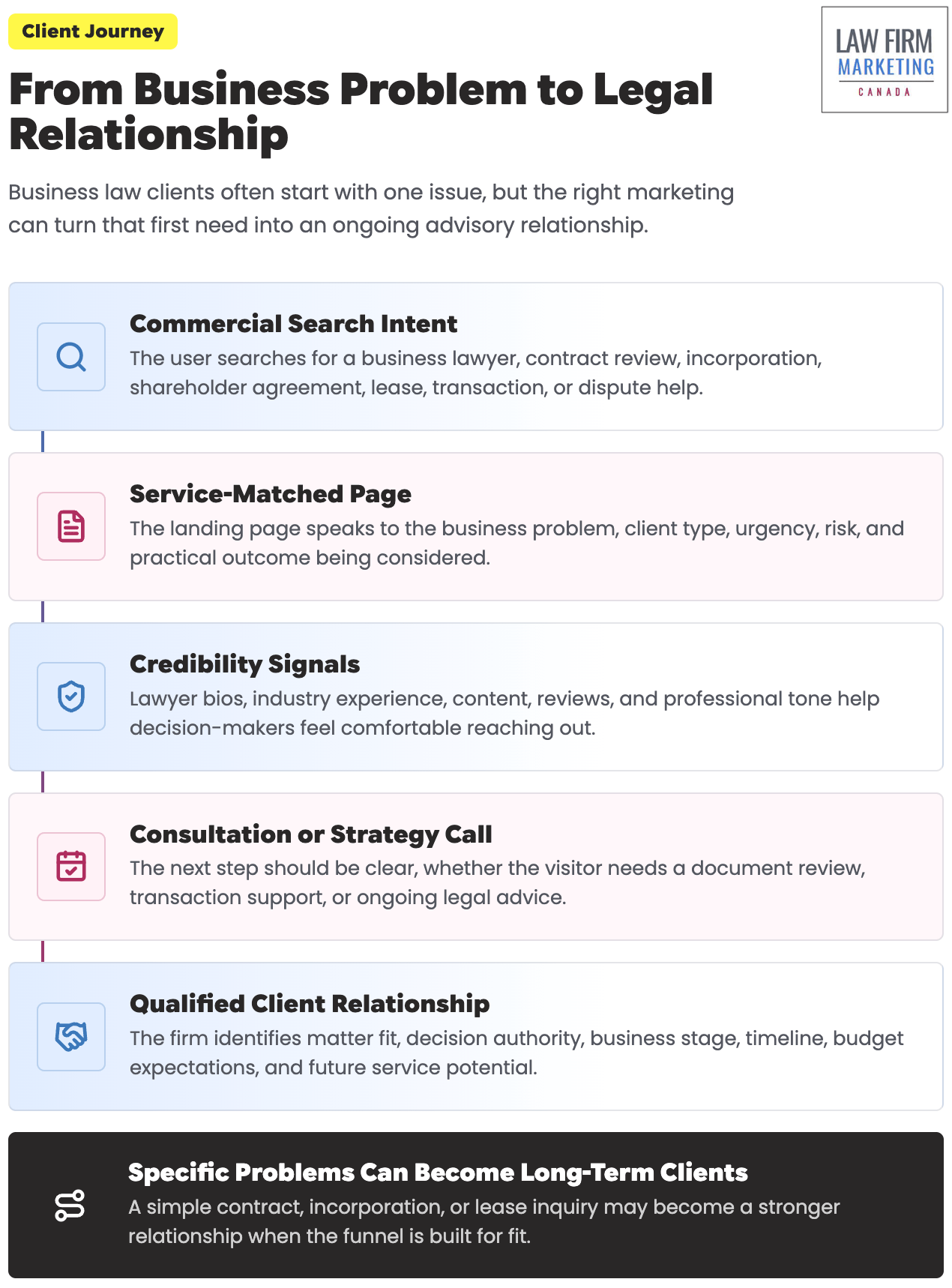
Business law landing pages should be specific, professional, and conversion-focused. A visitor who clicks an ad for commercial lease review should land on a commercial lease page. A founder searching for shareholder agreement help should land on a page about shareholder agreements. A business owner interested in outside general counsel should land on a page explaining ongoing legal support.
A strong business law landing page should identify the client type, explain the legal issue, describe how the firm helps, establish credibility, and make the next step clear. It should avoid vague legal language and focus on practical business outcomes.
Trust signals matter. Lawyer bios, industry experience, client types served, professional credentials, reviews, representative matter descriptions where appropriate, and clear consultation information can all improve conversion.
Business clients are often evaluating whether the firm understands their world. The landing page should make that clear quickly.

Review Strategy and Reputation for Business Law Firms
Reviews and reputation can influence business law clients, especially small business owners, founders, and professionals who compare firms online. Business clients want to know whether the lawyer is responsive, practical, knowledgeable, and commercially minded.
A strong review strategy includes encouraging appropriate client feedback, monitoring review platforms, responding professionally, and highlighting trust signals on the website. Reviews should always be collected and displayed ethically.
For business law firms, reviews may speak to responsiveness, clarity, practical advice, smooth transactions, strong contracts, and support during important business decisions. These signals can help prospective clients feel more confident booking a consultation.
Intake Optimization for Business Law Leads
Business law intake should identify the nature of the legal issue, business type, urgency, decision-maker status, budget expectations, timeline, and whether the prospect is a good fit for the firm. Not all inquiries are equal. Some may be low-value template requests, while others may become ongoing corporate clients.
A strong intake process helps filter inquiries and move qualified prospects toward consultations. It may include contact forms, qualification questions, CRM workflows, scheduling tools, call tracking, follow-up sequences, and reporting on which campaigns generate retained clients.
For business law firms, intake should also distinguish between one-time services and potential ongoing relationships. A simple incorporation inquiry may become a long-term client if handled strategically.
Law Firm Marketing Canada helps firms connect marketing performance with intake outcomes so campaigns can be optimized for quality, not just volume.
Branding and Creative Strategy for Business Law Marketing
Business law marketing should be practical, confident, and commercially relevant. The strongest messaging speaks to business outcomes, not abstract legal services.
Instead of saying, “We provide corporate legal services,” a stronger message might be, “Get legal documents and advice that support how your business actually operates.” Instead of saying, “We draft contracts,” a stronger message might be, “Protect your business before the agreement is signed.”
The best business law creative identifies the risk or opportunity clearly. A founder wants to avoid future disputes. A tenant wants to understand a lease before signing. A business owner wants to protect a sale. A growing company wants legal support without hiring in-house counsel.
Law Firm Marketing Canada helps business law firms create messaging that is specific, credible, and built to attract better clients.
Compliance and Professional Responsibility in Business Law Marketing
Business law advertising must be accurate, responsible, and aligned with applicable legal advertising rules. Firms should avoid misleading claims, guarantees, inappropriate comparisons, confidential information, or content that could be interpreted as legal advice for a specific situation.
Business law marketing should also be careful when discussing outcomes, risk reduction, disputes, transactions, and commercial consequences. The content should educate and invite prospective clients to seek advice based on their specific circumstances.
Law Firm Marketing Canada helps business law firms pursue growth while maintaining professionalism and compliance awareness.
Why Work With Law Firm Marketing Canada to Improve Your Business Law Firm’s Marketing?
Business law marketing requires more than general SEO or paid ads. It requires an understanding of business decision-makers, commercial intent, professional audiences, referral relationships, legal service positioning, and long-term client value.
Law Firm Marketing Canada specializes in digital marketing for lawyers and law firms. We understand that incorporation leads are different from M&A leads. We understand that shareholder agreement campaigns require different messaging than commercial litigation campaigns. We understand that LinkedIn can be especially valuable for firms targeting founders, executives, and professional audiences. We understand that the right business law client may become a long-term relationship, not just a one-time file.
Our team can help with business law SEO, Google Ads, Microsoft Advertising, LinkedIn advertising, social media advertising, YouTube campaigns, landing pages, content marketing, local SEO, AI search optimization, review strategy, referral marketing support, conversion tracking, intake reporting, and ongoing optimization.
The goal is not simply to generate more traffic. The goal is to help your firm attract more qualified business law inquiries and convert more of them into consultations, matters, and ongoing clients.
Request a Free Consulation
Fill out the form below to request your FREE consultation:
Frequently Asked Questions About Business Law Lawyer Marketing
Here are some common questions we are asked about law firm marketing:
What is business law lawyer marketing?
Business law lawyer marketing is the process of promoting a law firm’s business, corporate, commercial, and transactional legal services to companies, founders, entrepreneurs, executives, investors, and business owners. It can include SEO, Google Ads, LinkedIn advertising, local SEO, content marketing, landing pages, reviews, referral marketing, and intake optimization.
Why is business law marketing different from other legal marketing?
Business law marketing is different because clients are often business owners, founders, executives, or companies making commercial decisions. The messaging must be practical, professional, and focused on business risk, growth, contracts, transactions, and long-term legal support.
What marketing channels work best for business lawyers?
The strongest channels often include SEO, Google Ads, LinkedIn advertising, Microsoft Advertising, content marketing, local SEO, YouTube advertising, referral marketing, and retargeting. The right mix depends on the firm’s services, target industries, market, and growth goals.
Can SEO help business law firms get more clients?
Yes, SEO can help business law firms attract clients searching for business lawyers, corporate lawyers, shareholder agreements, commercial contracts, incorporation, franchise law, commercial leases, and business purchase or sale services. Strong SEO can also build authority through educational content.
Are Google Ads effective for business law firms?
Google Ads can be effective for business law firms when campaigns target specific services and high-intent searches. Campaigns should be separated by service type, such as incorporation, contract review, shareholder agreements, commercial leases, and business purchase transactions.
Is LinkedIn advertising useful for business lawyers?
Yes, LinkedIn advertising can be very useful for business lawyers because it allows firms to reach founders, executives, business owners, HR leaders, finance professionals, and industry-specific audiences. It is especially valuable for thought leadership, webinars, professional guides, and higher-value business development.
What should a business law firm website include?
A business law firm website should include clear service pages, industry pages where relevant, lawyer bios, FAQs, legal guides, reviews, calls to action, consultation information, and practical content that speaks to business risks and opportunities. It should make it easy for clients to understand what services the firm provides and who it serves.
How can business lawyers improve lead quality?
Business lawyers can improve lead quality through service-specific landing pages, better keyword targeting, LinkedIn audience targeting, qualifying intake forms, clear consultation messaging, negative keywords, CRM workflows, and campaign optimization based on retained clients and matter value rather than raw inquiry volume.
How long does business law marketing take to work?
Some channels, such as Google Ads and LinkedIn campaigns, can begin generating inquiries relatively quickly. SEO, content marketing, referral-building, and authority development usually take longer but can produce stronger long-term results. The timeline depends on competition, budget, website quality, and the firm’s current online presence.
Why should we hire Law Firm Marketing Canada for business law lawyer marketing?
Law Firm Marketing Canada understands both business law marketing and the legal industry. We help business law firms build strategies that combine SEO, paid ads, LinkedIn, content, landing pages, local visibility, referral support, tracking, and intake optimization. Our goal is to help your firm attract more qualified business clients and convert more of them into consultations and long-term relationships.
Trusted by clients across North America
See what our clients have to say about working with Law Firm Marketing Canada.


Mark Belanger, Managing Partner.


They created a marketing strategy that fit our specific needs as a company, and they really listened to what we were looking for.
We have seen a noticeable increase in our client inquiries since we started working together. Kamila and her team are always available to answer questions and offer insights, which makes a huge difference. Law Firm Marketing Canada has taken our online presence to the next level, and we are more than appreciative. Kamila has always been responsive, proactive, and always willing to go the extra mile to ensure our needs are met. It's clear she genuinely cares about what she is doing.
I highly recommend Law Firm Marketing Canada! We are so grateful to have them on our side and they are a real pleasure to work with.
Platforms we’re experts in:


